
The stakes are high. Companies invest millions in training programs, yet 75% of managers express dissatisfaction with learning and development initiatives. Interactive, engaging training activities solve this problem by tapping into how adults actually learn best—through experience, collaboration, and yes, enjoyment.
Fun staff training ideas transform mundane learning sessions into powerful engagement tools that drive real results. Traditional training methods leave employees disengaged and information forgotten within days. Group Dynamix specializes in creating tailored team-building experiences that stick with participants long after the session ends, fostering genuine skill development and stronger workplace relationships.
Benefits of Corporate Team Building?
Benefits of Corporate Team Building?
TL;DR:
This guide presents 23 interactive training activities that transform traditional learning into engaging experiences. Research shows 83% of employees feel motivated during gamified training compared to just 39% with conventional methods. These activities range from quick icebreakers to technology-enhanced simulations, each designed to boost knowledge retention and team cohesion.
Key Takeaways:
- Icebreakers build psychological safety and accelerate team bonding from the first minute
- Interactive learning methods help participants retain 54% more information than traditional approaches
- Gamified training achieves a 90% completion rate versus 25% for standard e-learning
- Creative problem-solving exercises develop resilience and adaptability
- Technology-enhanced training creates immersive, risk-free practice environments
- Measurement frameworks and ongoing support separate effective training from wasted investment
Why Fun Staff Training Ideas Are Essential for Modern Workplaces
Training doesn’t have to feel like detention. Smart organizations recognize that engagement drives results, not compliance. When employees genuinely enjoy learning, they retain more, apply skills faster, and develop stronger collaborative relationships.
The Psychology Behind Engaging Training Methods
Your brain rewards interesting experiences. Engaging training methods activate emotional and cognitive pathways that cement learning into long-term memory. Recent research confirms that interactive social learning increases both motivation and knowledge retention significantly compared to passive instruction.
The science is clear: positive emotions during learning trigger dopaminergic responses that reinforce memory encoding. When training includes elements of surprise, collaboration, or friendly competition, participants naturally revisit and build upon what they’ve learned.
Psychological safety matters too. Interactive activities that encourage participation without judgment create spaces where employees feel comfortable taking risks and sharing ideas. Google’s Project Aristotle identified psychological safety as the most important factor for team success, accelerating learning and building the trust necessary for high-performing teams.
Measurable Benefits of Interactive Training Approaches
The numbers tell a compelling story. Interactive learning methods deliver participants who score 54% higher on knowledge-based tests than peers in traditional environments. That’s not a marginal improvement—it’s transformational.
Training activities for employees that incorporate gamification report even more dramatic results. Gamified courses achieve completion rates near 90%, while standard e-learning hovers around 25%. Employees also retain 22% more information from gamified training than conventional methods.
Business outcomes improve alongside learning metrics. Companies using gamified training saw a 25% increase in fee collection, 22% more new opportunities, and 16% growth in client relationships.
Real Results from GroupDynamix Clients: A mid-sized Dallas tech company approached GroupDynamix struggling with cross-departmental silos that delayed product launches. After implementing a customized “Island Rescue” program focused on collaborative problem-solving, the company measured a 40% reduction in interdepartmental project delays over the following quarter. Team members reported spending 30% less time in clarification meetings, directly attributing the improvement to communication skills developed during training. The facilitated debrief connected island survival challenges to actual workflow bottlenecks, creating an immediate bridge between training insights and workplace application.
Common Training Challenges That Fun Activities Solve
Modern organizations face predictable training obstacles. Information overload overwhelms employees presented with dense materials in marathon sessions, yet 61% of L&D professionals cite measuring effectiveness as their top challenge. This measurement gap makes it nearly impossible to justify ongoing investment or adjust failing strategies.
Content misalignment compounds the problem. When 75% of managers express dissatisfaction with L&D initiatives because training doesn’t match evolving business goals, organizations waste resources on irrelevant content. Rapid digital transformation, affecting 91% of firms, often outpaces content updates.
Employee resistance stems from this disconnect. Nearly 49% of workers admit to skipping or tuning out compliance training, indicating a fundamental breakdown between completion rates and actual learning. Interactive training techniques that involve participants in their own learning transformation address this resistance by making training immediately applicable and personally meaningful.
Skills gaps continue widening as technology evolves faster than traditional training programs can adapt. Training game approaches break content into digestible chunks while providing safe spaces to practice emerging competencies, bridging the gap between knowing and doing.
Without reinforcement, even engaging training fails. Employees forget up to 80% of content within a month absent follow-up activities or regular refreshers, explaining why companies focusing exclusively on single-event training see significantly lower skill retention. Group Dynamix designs custom programs addressing these exact challenges, ensuring participants gain skills while strengthening team bonds through structured follow-up and measurement.
Energizing Icebreakers and Team-Building Activities (Ideas 1-5)
Icebreakers set the tone for everything that follows. Done right, these activities lower social barriers, spark conversations, and create the psychological safety necessary for meaningful learning.
Two Truths and a Lie with Professional Twist
This classic game gets a workplace upgrade. Participants share three statements about their professional background or skills—two true, one false. Colleagues guess which statement is the lie, sparking conversations about hidden talents and shared experiences.
The professional twist matters. Focus statements on work experiences, technical skills, or career aspirations to keep the activity relevant while revealing unexpected expertise within your team.
Human Bingo for Skills Discovery
Create bingo cards featuring specific skills, experiences, or attributes relevant to your workplace. Participants circulate, finding colleagues who match each square’s description, winning while gaining insight into team capabilities.
Smart cards include items like “speaks more than two languages,” “has led a cross-functional project,” or “knows advanced Excel formulas.” This reveals hidden resources while encouraging natural conversations between people who might not otherwise connect.
Desert Island Leadership Challenge
Present teams with a scenario: stranded on a desert island with limited resources, which items would they prioritize for survival? Participants must reach consensus on their top five items, negotiating priorities and explaining their reasoning.
This deceptively simple activity reveals leadership styles, decision-making processes, and communication patterns. The post-activity debrief connects decisions to workplace scenarios—how does your team balance short-term urgencies with strategic planning?
One-Word Vision Alignment
Each participant selects one word describing their vision for the team, project, or organization’s future. Words get shared and discussed, revealing alignment, gaps, and opportunities for building shared understanding.
One-word responses force clarity and prioritization. When someone chooses “innovation” while another picks “stability,” productive conversations about balancing competing values emerge naturally.
Shared Story Chain Building
The group collaboratively builds a story, with each person adding one sentence. The narrative can be work-related or purely creative, depending on your training objectives.
This activity develops active listening and adaptability. Participants must pay attention to what came before while contributing something meaningful. When someone takes the story in an unexpected direction, others must pivot and adjust—exactly what’s required in dynamic work environments.
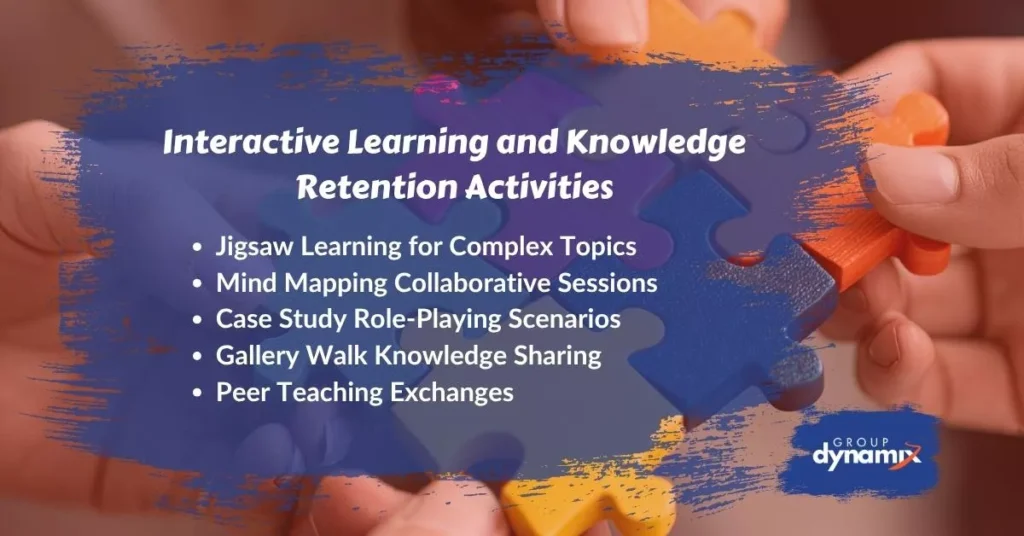
Interactive Learning and Knowledge Retention Activities (Ideas 6-10)
Passive learning doesn’t stick. Interactive approaches that require active participation, collaboration, and application dramatically improve how much information employees retain and use.
Jigsaw Learning for Complex Topics
Break complex subjects into segments, assigning each small group responsibility for one piece. Groups become experts in their segment, then regroup to teach other participants. Everyone becomes both learner and teacher.
This approach works exceptionally well for technical training or process documentation. When team members must teach content, they engage with material at a deeper level than passive review permits.
Mind Mapping Collaborative Sessions
Teams visually map relationships between concepts, starting with a central idea and branching outward with related themes, details, and connections. Digital tools enable remote teams to participate equally, while physical mind maps work beautifully for in-person sessions.
The visual format helps different learning styles engage with content. Linear thinkers appreciate the logical structure while visual learners grasp relationships through spatial arrangement.
Case Study Role-Playing Scenarios
Present realistic workplace scenarios and assign participants roles with specific perspectives, goals, and constraints. Teams work through the case, making decisions and addressing challenges as their characters would.
Role-playing substantially improves learners’ ability to analyze complex issues and transfer understanding to actual work situations. When participants embody different stakeholder perspectives, they develop empathy and strategic thinking simultaneously.
Gallery Walk Knowledge Sharing
Post different topics, questions, or challenges around the room. Small groups rotate through stations, adding insights, questions, or solutions to each display. Subsequent groups build on previous contributions, creating layered understanding.
This format encourages iteration and collaborative refinement. The physical movement between stations also provides energizing breaks from seated learning. Virtual adaptations use collaborative documents or digital whiteboards.
Peer Teaching Exchanges
Pair participants and have them teach each other specific skills or concepts. The teaching requirement forces articulation and organization of knowledge. Receiving teaching from a peer often feels less intimidating than expert instruction, creating space for authentic questions.
Structure peer teaching with clear time limits and specific learning objectives. Follow-up discussions should celebrate effective teaching strategies and troubleshoot challenges.
Gamification and Competition-Based Training (Ideas 11-15)
Competition activates engagement like few other training approaches. When done thoughtfully, competitive elements motivate without creating destructive rivalries.
Kahoot! Quiz Championships
Interactive quiz platforms transform review sessions into exciting competitions. Participants answer questions using their devices, with points awarded for speed and accuracy. Real-time leaderboards create energy while reinforcing key concepts.
90% of employees report that gamification makes them more productive. Quiz championships deliver this benefit through accessible technology requiring minimal setup.
Escape Room Problem-Solving Challenges
Physical or digital escape rooms require teams to solve puzzles, crack codes, and uncover clues within time limits. These immersive experiences develop critical thinking, communication, and resource management under pressure.
Companies report that escape room challenges surface leadership dynamics and problem-solving approaches in ways traditional training cannot. Custom escape rooms can embed training content directly into puzzles—a compliance-focused room might require decoding policy documents to unlock the next clue.
Training Scavenger Hunts
Participants complete challenges, answer questions, or find items scattered across physical or digital environments. The format works for orientations, product launches, or process training.
Scavenger hunts naturally encourage exploration and discovery. Rather than being told information, participants actively seek it out. Digital versions adapt beautifully for remote teams through QR codes, photo challenges, and online puzzle components.
Skills-Based Tournament Brackets
Structure competitive brackets around specific skills or knowledge areas. Participants advance through rounds by demonstrating proficiency, with difficulty increasing at each stage.
Tournament structures work particularly well for sales training, technical certifications, or customer service scenarios. Transparency about advancement criteria prevents frustration—clear rubrics ensure tournaments feel fair and learning-focused.
Trivia Competitions with Industry Focus
Industry-specific trivia tests knowledge while highlighting lesser-known facts and trends. Format competitions as team events to encourage knowledge sharing and collective problem-solving.
AstraZeneca’s “Go to Jupiter” gamified learning program achieved 97% participation among 500 sales agents through team-based competitions. Participants engaged outside work hours because the format made learning genuinely enjoyable and social.
Creative Problem-Solving and Innovation Exercises (Ideas 16-20)
Innovation doesn’t happen in comfort zones. These activities push participants to think differently, experiment freely, and embrace temporary failure as part of learning.
Marshmallow Tower Engineering Challenge
Teams receive simple materials—spaghetti, tape, string, and one marshmallow. Their challenge: build the tallest freestanding structure supporting the marshmallow on top.
This classic activity reveals how teams approach planning, testing, and iteration. Some groups plan extensively before building, others prototype rapidly. Discussing these different approaches afterward connects to workplace project management.
Reverse Brainstorming Sessions
Instead of generating solutions, teams brainstorm how to cause or worsen a problem. This counterintuitive approach often surfaces root causes and hidden assumptions traditional brainstorming misses.
Nearly half of Fortune 500 companies have integrated reverse brainstorming into leadership programs since 2023. The technique works because it’s easier to identify what would make situations worse than imagine perfect solutions.
Improv Training for Communication Skills
Improvisation exercises develop active listening, adaptability, and collaborative storytelling. The core principle—”yes, and”—teaches participants to build on others’ contributions rather than shutting down ideas.
Both Google and Slack have formally integrated improv training into employee development. Results include notable productivity boosts, with 93% of participants reporting improvement after receiving empathetic, improv-driven recognition from managers.
GroupDynamix Implementation Example: A Dallas-based financial services firm struggled with rigid communication patterns that stifled innovation. Their customized Communication Lab program incorporated improv exercises specifically designed for conservative corporate environments. Within three months, the company measured a 25% increase in cross-functional project proposals and a 35% improvement in team collaboration scores. Participants reported feeling more comfortable sharing unconventional ideas, with one manager noting, “The ‘yes, and’ principle completely changed how our leadership team responds to new initiatives.”
Build-It Challenges with Limited Resources
Provide teams with random or limited materials and challenge them to construct something specific—a bridge spanning a gap, a protective container for a fragile item, or a functional prototype solving a stated problem.
Resource constraints force creativity and prioritization. Teams can’t rely on unlimited supplies or perfect conditions—they must innovate within limitations, exactly as they must in actual work environments.
Innovation Pitch Competitions
Teams develop and present solutions to real organizational challenges. Judges evaluate presentations on creativity, feasibility, and potential impact.
H&M Group implemented innovation pitch competitions as part of upskilling initiatives, reporting decreased voluntary attrition among participating employees. The format taps into competitive energy while generating genuinely useful ideas for the organization.
Technology-Enhanced Interactive Training (Ideas 21-23)
Digital tools expand training possibilities, creating immersive experiences impossible through traditional methods.
Virtual Reality Skill Simulations
VR training places participants in realistic scenarios where they practice skills without real-world consequences. Healthcare workers perform procedures, retail staff navigate difficult customer interactions, and warehouse employees operate equipment—all in safe, repeatable virtual environments.
Walmart deployed VR training for over a million employees, achieving a 10% increase in customer service scores. Employees practiced handling Black Friday rushes virtually, developing confidence and decision-making skills that transferred directly to actual high-pressure situations.
Augmented Reality On-the-Job Training
AR overlays digital information onto physical environments, providing real-time guidance during actual work. Technicians see repair instructions hovering over equipment, warehouse workers receive visual directions to product locations.
Current data shows 4% of organizations use AR in training, though interest continues growing. The technology excels at bridging knowing and doing—employees apply guidance immediately in authentic contexts rather than hoping to remember classroom instruction.
Gamified Mobile Learning Apps
Mobile platforms deliver bite-sized learning through apps incorporating game mechanics—progress bars, achievement badges, competitive leaderboards, and rewards. Employees learn during commutes, breaks, or whenever they have spare minutes.
IBM implemented gamified mobile learning with AI personalization, achieving a 30% improvement in productivity and 50% faster time to competency for new roles.
Choosing the Right Training Activities for Your Team
Selecting effective training activities requires more than browsing a list. Success depends on matching methods to your specific context, team needs, and measurable objectives.
Decision Framework for Training Selection
Start with thorough assessment. Customized interventions that address specific gaps in communication, trust, or role clarity deliver higher impact than generic, off-the-shelf activities. Consider these criteria:
Team Size and Structure: Activities for teams under 20 work differently than those for large distributed groups. Small teams benefit from intimate activities like Desert Island Challenge or Peer Teaching that require deep participation from everyone. Large teams need scalable formats like Kahoot! Championships or Scavenger Hunts that maintain energy across dozens of participants.
Remote vs. In-Person: Virtual teams require technology-enabled solutions—Mind Mapping using digital whiteboards, online Escape Rooms, or mobile learning apps. Hybrid formats like Microsoft’s “Survey Showdown” that connected remote and in-person participants across continents demonstrate how thoughtful design bridges location barriers.
Specific Skill Gaps: Technical skills training benefits from Jigsaw Learning or VR Simulations. Leadership development calls for Role-Playing Scenarios or Innovation Pitches. Communication challenges respond to Improv Training or Gallery Walks. Match method to objective rather than choosing activities that simply sound interesting.
Budget Considerations: Technology-enhanced options like VR require significant upfront investment but scale efficiently for ongoing use. Low-cost activities like Marshmallow Towers or Reverse Brainstorming deliver powerful results with minimal materials. Budget constraints shouldn’t prevent effective training—many high-impact activities cost almost nothing to implement.
Common Implementation Pitfalls
Even engaging activities fail without proper execution. Training implementations most commonly fail due to inadequate measurement, with 61% of L&D professionals struggling to measure effectiveness.
Insufficient Facilitation Skills: High-quality facilitation creates psychological safety, provides real-time feedback, and adapts on-the-fly to learner needs. Facilitators who lack these skills undermine even well-designed activities. Only 5% of organizations offer leadership training at all employment levels, reflecting a critical lack of facilitator development. GroupDynamix addresses this by providing skilled facilitators who manage logistics, maintain energy, and guide reflection—ensuring participants walk away with actionable insights.
Competitive Activities That Backfire: Competition motivates most people, but poorly designed competitive training can damage relationships and reinforce harmful behaviors. When winning becomes more important than learning, or when competition highlights existing power imbalances, activities undermine their objectives. Solution: Structure competitions around team performance rather than individual winners, celebrate improvement alongside absolute performance, and ensure clear learning-focused criteria.
One-Time Events Without Reinforcement: Employees forget up to 80% of training content within a month without follow-up. Companies focusing exclusively on single-event training rather than continuous, bite-sized modules see significantly lower skill retention. Embed reinforcement tactics—microlearning refreshers, scenario-based follow-ups, regular team check-ins—to cement knowledge and skills.
Content Disconnected from Business Reality: When training content isn’t tailored to evolving business goals, 75% of managers express dissatisfaction. Activities must connect explicitly to actual workplace challenges. During debriefs, facilitators should ask: “How does this relate to the project you’re working on right now?” Generic insights that don’t translate to daily work evaporate quickly.
When Traditional Training Still Makes Sense
Interactive methods aren’t universal solutions. Certain situations call for traditional approaches. Complex compliance requirements often need structured lectures to ensure precise information delivery. Highly technical content with no room for experimentation may require demonstration and controlled practice rather than open-ended exploration.
The key is balance. Even traditional training improves by incorporating interactive elements—brief discussions, practical application exercises, or peer review. Conversely, highly interactive training should include moments of direct instruction when foundational knowledge requires clear explanation.

Measuring Your Training Investment
Effective training measurement separates genuine development from feel-good activities that fail to deliver business value. Organizations that track the right metrics demonstrate ROI and continuously improve their training programs.
Essential Training Metrics to Track
Top-performing companies use structured evaluation frameworks to measure training effectiveness. The most widely-used methodology, the Kirkpatrick Model, evaluates training across four levels:
Reaction: Measure learner satisfaction and engagement through post-training surveys, participation rates, and Net Promoter Scores. While positive reactions don’t guarantee learning, consistently negative feedback signals fundamental problems requiring immediate attention.
Learning: Assess knowledge or skill gain using pre- and post-training tests, practical assessments, or peer reviews. A tech firm using gamified sales simulations might measure improvement on product knowledge tests, demonstrating actual learning occurred.
Behavior: Track changes in workplace behavior through supervisor observation, self-reporting, or performance metrics. Do participants actually apply new skills? Sales close rates, customer satisfaction scores, or project completion times provide concrete behavioral evidence.
Impact: Quantify business outcomes—increased productivity, improved quality, higher retention rates. This level connects training directly to organizational objectives, making ROI calculation possible.
The Phillips ROI Model adds a fifth level: direct financial ROI. Calculate net benefit (business value achieved minus total training costs) divided by training costs, multiplied by 100 for ROI percentage. If a cybersecurity training program costs $250,000 but saves $1,000,000 in breach prevention, ROI equals 300%.
Simple Before/After Assessment Framework
Establish baseline measurements before training begins. Track specific, measurable goals: reduce support ticket resolution time by 30%, improve compliance scores by 15%, increase cross-functional collaboration by 25%. Choose metrics that align directly with training objectives.
During training, monitor engagement indicators: completion rates, participation levels, assessment scores. These provide early signals about training effectiveness and identify participants who may need additional support.
Post-training, measure the same metrics at 30, 60, and 90 days. Knowledge retention decays rapidly without reinforcement, so tracking at multiple intervals reveals both immediate impact and long-term effectiveness. Compare results against baseline and industry benchmarks.
Realistic Timelines for Results
Different training types produce results on different schedules. Skill-based training—learning software, improving presentation abilities—shows measurable improvement within weeks. Behavioral changes—enhanced collaboration, better conflict resolution—require months of consistent practice and reinforcement. Cultural shifts—improved psychological safety, increased innovation—manifest gradually over quarters or years.
Set expectations accordingly. Leaders frustrated that teamwork training didn’t transform culture in three weeks likely set unrealistic timelines. Conversely, technical training that hasn’t improved performance after 90 days probably suffers from design flaws or insufficient practice opportunities.
How GroupDynamix Supports Training Measurement
Group Dynamix integrates measurement into program design from the start. Pre-program consultations identify specific, measurable objectives tied to your business needs. Customized activities target those exact outcomes, ensuring training addresses real gaps rather than generic development.
During programs, facilitators observe and document team dynamics, communication patterns, and problem-solving approaches. These qualitative insights complement quantitative metrics, providing a complete picture of team functioning.
Post-program debriefs connect activity insights to workplace application, with structured follow-up recommendations. Many clients implement brief pulse surveys at 30 and 60 days, measuring whether insights translated to changed behaviors. This accountability loop ensures training investment produces lasting value rather than temporary engagement.
Group Dynamix: Let Us Train Your Staff
Implementing innovative training methods requires expertise, planning, and facilitation skills. Group Dynamix specializes in creating customized team-building and training experiences that transform theoretical concepts into practical, memorable learning.
Unlike providers who simply offer spaces or generic activities, Group Dynamix designs programs tailored to your specific organizational needs. Programs like Team Olympix combine friendly competition with collaboration, Island Rescue challenges teams with adventure-based problem-solving, and Communication Lab improves workplace dialogue through interactive experiments.
The difference lies in customization and facilitation. Activities adapt to group size, physical abilities, venue constraints, and corporate goals. Professional facilitators manage logistics, maintain energy, and guide reflection—ensuring participants walk away with strengthened relationships, boosted morale, and genuinely improved capabilities.
Group Dynamix serves organizations across Dallas seeking more than empty team-building clichés. Clients choose their services for measurable outcomes: new connections, practical skills, and teams that function better long after events conclude.
Engaging Company Events
Corporate Events, Group Outings, Private Events, Charities, Meetings, and More...
Engaging Company Events
Corporate Events, Group Outings, Private Events, Charities, Meetings, and More...
Conclusion
Fun staff training ideas aren’t frivolous—they’re strategic investments in engagement, retention, and capability development. Research consistently demonstrates that interactive, engaging training methods outperform traditional approaches: 54% higher knowledge retention, 90% completion rates, and measurable business impact.
The 23 activities outlined here span from quick icebreakers to technology-enhanced simulations, each addressing specific learning objectives while maintaining the engagement that makes training effective. Success requires more than randomly selecting activities. Thoughtful assessment, skilled facilitation, proper measurement, and ongoing reinforcement separate effective training from wasted investment.
Group Dynamix brings this expertise, crafting customized training experiences that deliver lasting impact through programs designed around your specific challenges, facilitated by professionals who ensure insights translate to workplace application, and supported by measurement frameworks that demonstrate ROI.
Your team deserves training that respects their time, honors different learning styles, and produces measurable results. The evidence is overwhelming—engaging training works. The question is when you’ll start implementing these approaches in your organization.
Ready to transform your staff training from forgettable to unforgettable? Connect with Group Dynamix to design a customized program that engages your team while building the skills your organization needs to thrive in 2025 and beyond.