
When you build trust in teams, you unlock the single most powerful driver of performance, engagement, and collaboration. Yet trust doesn’t happen by accident. It requires intentional strategies, consistent action, and a willingness to create environments where people feel safe, valued, and connected. Whether you’re leading a remote team, navigating hybrid work challenges, or simply looking to strengthen your team’s foundation, the right approach can transform how your people work together.
At Group Dynamix, we’ve seen firsthand how tailored, facilitated experiences help teams develop trust through shared challenges, open communication, and genuine connection. Our customized programs push participants beyond their comfort zones in supportive environments, building the psychological safety and mutual understanding that high-performing teams depend on. Ready to strengthen your team? Explore our team-building programs designed to create lasting trust and collaboration.
Benefits of Corporate Team Building?
TL;DR: Build Trust in Teams: 7 Proven Strategies
Building trust within teams requires more than good intentions. It demands transparency in communication, vulnerability from leaders, clear expectations paired with fair accountability, and environments where people feel safe to take risks. Teams thrive when leaders demonstrate competence through consistent follow-through, recognize contributions meaningfully, and invest in genuine connections beyond work tasks. Trust can be measured through engagement signals and rebuilt after breaches with honest acknowledgment and sustained action. The most effective approach starts with one focused strategy, involves team input, and tracks progress over time.
Key Points:
- Teams with high engagement deliver 23% higher profitability than low-engagement teams, with trust and psychological safety as core drivers.
- 68% of employees report that low trust directly harms their daily productivity and effort.
- Transparent communication boosts engagement significantly, with 85% of employees feeling more engaged when leaders communicate openly.
- Recognition matters: employees who receive meaningful monthly recognition report 3 times more trust in their managers.
- Modern work environments create unique trust challenges through proximity bias, productivity surveillance, and weaker informal connections in remote and hybrid settings.

Why Trust Is the Foundation of High-Performing Teams
Trust acts as the invisible infrastructure that determines whether teams merely function or truly excel. When trust is present, collaboration flows naturally, people share ideas freely, and teams navigate challenges with resilience. Without it, even talented individuals struggle to coordinate effectively, leading to siloed work, guarded communication, and missed opportunities.
The most successful teams don’t treat trust as a soft skill or a nice-to-have cultural element. They recognize it as a measurable performance multiplier that directly impacts results, innovation, and retention.
The Business Impact of Trust (or Lack Thereof)
The financial case for trust is compelling. Research analyzing more than 183,000 teams found that high-engagement teams, where trust and psychological safety are strong, achieve 23% higher profitability compared to their low-engagement counterparts. These same teams show roughly 18% higher sales productivity and approximately 14% stronger performance on production measures.
The cost of broken trust is equally dramatic. In organizations with typically low turnover, business units suffering from low employee engagement experience 51% higher turnover than highly engaged units. When people don’t trust their leaders or teammates, they leave. Those who stay often disengage mentally, with 68% of employees reporting that low trust actively undermines their daily productivity and effort.
Trust also determines whether teams can recover from setbacks. Organizations that maintain trust through difficult periods retain institutional knowledge, preserve customer relationships, and adapt faster to changing conditions. Those that allow trust to erode face compounding challenges as cynicism spreads and talented people exit.
How Modern Work Environments Challenge Team Trust
Today’s distributed and hybrid work models have fundamentally changed how teams build and maintain trust. The casual hallway conversations, spontaneous problem-solving sessions, and informal relationship-building that once happened naturally now require deliberate design and effort.
Proximity bias creates structural trust gaps. Leaders often give more opportunities, better evaluations, and greater trust to people they see in person regularly, leaving remote workers feeling undervalued regardless of their actual contributions. This visibility advantage signals that trust is tied to physical presence rather than demonstrated competence and results.
Productivity paranoia has emerged as another trust killer in remote environments. Some managers struggle to believe employees are working effectively when they can’t see them, leading to increased surveillance, activity tracking, and pressure to appear constantly available online. These monitoring behaviors communicate distrust and create exactly the disengagement they aim to prevent.
Communication friction compounds these challenges. Without shared physical context, teams must navigate time zones, unclear norms about when to use which channels, and an overload of poorly structured meetings. Research shows that employees with low psychological safety are about four times more likely to want to quit and roughly a third less motivated to perform their best work, highlighting how critical it is to address these connection and safety barriers intentionally.
Strategy 1: Communicate with Radical Transparency
Transparency isn’t just about sharing information; it’s about building credibility through openness, honesty, and consistent two-way dialogue. When teams operate transparently, people feel included in the bigger picture, understand how their work connects to outcomes, and trust that leaders aren’t hiding important realities.
Radical transparency means defaulting to openness rather than secrecy, sharing context along with decisions, and creating channels where honest feedback flows in both directions without fear of retaliation. Yet transparency has limits. The goal is maximum appropriate transparency, not reckless disclosure that violates privacy laws, commercial obligations, or confidential HR matters.
Share Information Early and Often
Waiting to share information until everything is certain or polished often backfires. By the time formal announcements arrive, informal networks have already filled the void with speculation and anxiety. Early sharing demonstrates respect for people’s ability to handle complexity and ambiguity.
Make a habit of sharing work-in-progress thinking, market realities, strategic trade-offs, and organizational constraints. When people understand not just what is happening but also what you know and don’t know, they can contribute more effectively and feel genuinely included rather than managed.
What this looks like in practice:
You know transparency is present when your VP walks the team through three strategy options being debated at the leadership level, acknowledging she doesn’t yet know which will be chosen; when project leads share customer feedback in real-time, including the harsh criticism; when budget constraints are explained with actual numbers rather than vague “we need to tighten belts” statements; or when the team discusses a competitor’s move before leadership has formulated the official response.
How to Structure Your First Transparency Retrospective
Many teams successfully build transparency through weekly check-ins and shared documentation. When trust has been severely damaged, when power dynamics prevent honest dialogue, or when teams lack experience structuring productive conversations, professional facilitation can add value by creating psychological safety and ensuring all voices are heard.
30-60 minute framework:
Start by asking: “What decision in the last month caught you by surprise?” Let each person share without interruption. Then explore: “What context would have helped you understand or contribute?” and “What information do we need flowing regularly that isn’t right now?”
Common pitfall: leaders explaining decisions defensively rather than exploring what information flow broke down. Instead, focus on designing better systems: “How can we make strategic thinking more visible going forward?” Document three specific communication changes to implement immediately.
Close by identifying what will remain confidential and why. When constraints prevent addressing a concern, explain why honestly rather than ignoring it. Authentic dialogue about limitations builds more trust than polished but incomplete messaging.
Explain the ‘Why’ Behind Decisions
Decisions without context breed mistrust. Even when people disagree with a choice, they can accept it more readily when they understand the reasoning, constraints, and values that shaped it. Explaining the “why” transforms directives into shared sense-making.
Surface the trade-offs you considered, the data you weighed, and the principles you applied. When you make priorities visible, people can challenge assumptions constructively rather than simply complying without understanding. This openness invites better solutions and builds trust that leadership is making thoughtful choices rather than arbitrary calls.
Organizations that implement regular feedback mechanisms report 14.9% lower turnover rates, demonstrating how consistent expectations and dialogue strengthen retention and trust.
Create Open Channels for Two-Way Communication
One-way transparency isn’t enough. Trust requires channels where team members can ask hard questions, surface concerns, and offer dissenting views without negative consequences. These mechanisms signal that leadership wants the truth, not just compliance.
Establish structured forums like regular retrospectives, open Q&A sessions, anonymous feedback systems, and direct access to decision-makers. More importantly, respond visibly to what you hear. When people see their input acknowledged and acted upon, they trust that their voice matters.
How Group Dynamix Can Help: Our communication-focused workshops reveal how easily information breakdowns occur under pressure and teach techniques for clear, respectful dialogue when stakes are high. These facilitated experiences help teams practice transparency in controlled settings before applying it to real work challenges. Contact us to design a program for your team.
Strategy 2: Lead with Vulnerability and Authenticity
Leaders who show vulnerability and authenticity create permission for everyone else to do the same. This doesn’t mean oversharing personal struggles or undermining your authority. It means being honest about uncertainty, acknowledging mistakes quickly, and treating your humanity as a strength rather than a weakness to hide.
When leaders model vulnerability-based trust, teams shift from performance theater to genuine collaboration, where admitting you don’t know something or need help becomes normal rather than risky.
Why Leaders Must Go First
Vulnerability flows downhill. Team members take their cues about what’s safe from watching leaders. If you project infallibility and certainty at all times, your team will do the same, hiding struggles and mistakes until problems escalate beyond repair.
Research on leader humility found that when leaders model authentic acknowledgment of their limitations, followers paradoxically feel less vulnerable themselves. This creates psychological safety that allows teams to surface problems early, ask for help without shame, and experiment without fear of judgment.
What leader vulnerability looks like:
Instead of presenting a finished strategy as inevitable, a director shares: “I’m torn between focusing on retention or acquisition. Here’s my current thinking and where I’m uncertain. Challenge my assumptions.” When the product launch hits a snag, the VP says in the all-hands: “I pushed for this timeline despite warnings from the team. That was my error, and here’s what I’m learning about balancing speed and quality.”
Practical Ways to Show Vulnerability Without Undermining Authority
Balance vulnerability with competence. Share that you don’t have all the answers while demonstrating your commitment to finding them. Admit when you’ve made a mistake while taking clear ownership and outlining what you’ll do differently. Ask for help while showing you’re capable of learning and adapting.
Specific practices that work include narrating your decision-making process aloud, sharing what you’re struggling with professionally, asking team members to challenge your assumptions, and publicly crediting others when their input improves your thinking. These behaviors humanize leadership without creating doubt about your ability to guide the team.
When vulnerability backfires:
Vulnerability-based leadership fails when senior leaders ask employees to share fears or failures without matching it with their own risk-taking and without changing structural risks like punitive evaluation systems. Employees may feel coerced into disclosure that can later be used against them. Make leader vulnerability costly to the leader, not to employees: go first with sharing real uncertainty and past mistakes that matter, and pair this with visible commitments like protecting dissenters from retaliation. Keep psychological safety about work challenges, not therapy. Make participation voluntary and set norms that personal disclosures are never used in performance discussions.
Encourage Team-Wide Vulnerability
Once you’ve modeled vulnerability as a leader, actively invite your team to practice it. Start meetings with check-ins that go beyond work status, ask people to share something they’re learning or struggling with, and respond with curiosity and support when someone admits uncertainty or mistakes.
Create explicit norms such as “we acknowledge what we don’t know,” “asking for help is a sign of strength,” and “mistakes are learning opportunities, not character judgments.” When these principles are named and reinforced consistently, vulnerability becomes a team norm rather than an individual risk.
Troubleshooting vulnerability resistance:
If vulnerability feels forced or awkward, start smaller with professional vulnerability (“I’m unsure about our pricing strategy”) before personal vulnerability. If leaders share but teams don’t reciprocate, explicitly invite it: “I shared my struggle; who else is working through something?” and respond with visible appreciation when someone takes the risk. If cultural norms around hierarchy or face-saving make Western-style vulnerability uncomfortable, adapt by using anonymous channels, representative councils, or framing vulnerability around collective challenges rather than individual failures.
How Group Dynamix Can Help: Our adventure-approach events intentionally push participants beyond comfort zones in supported environments, prompting leaders to acknowledge fears, admit uncertainty, and ask teammates for assistance. These shared experiences normalize the vulnerability that high-trust teams require. Explore our programs.

Strategy 3: Establish Clear Expectations and Accountability
Trust flourishes when people know exactly what’s expected of them and how they’ll be held accountable. Vague standards and inconsistent follow-through breed confusion and resentment, while clarity and fairness build confidence that the system is reliable and equitable.
The goal is accountability anchored in psychological safety, not fear. People should feel supported in meeting high standards rather than afraid of arbitrary judgment.
Define Roles, Responsibilities, and Success Metrics
Translate each role into five to seven specific responsibilities and three to five measurable outcomes. Document these clearly and discuss them explicitly rather than leaving them to interpretation. When people understand their lane, they can own their work without constant supervision or second-guessing.
Review and adjust expectations collaboratively at least quarterly. Make changes transparent by calling out what shifted and why. This practice prevents the “moving goalposts” problem that erodes trust faster than almost anything else.
39% of workers reported lack of recognition for contributions as a primary driver of poor employee experience, while 25% cited insufficient collaboration or support within teams. Clear expectations around what will be recognized and how people can support each other address both gaps simultaneously.
The 5-Component Accountability Check-In
Many teams successfully implement accountability through simple weekly stand-ups or shared project trackers. When accountability has broken down, when teams are newly formed, or when remote work makes progress invisible, a structured framework ensures consistency.
Run these weekly in 15-minute rotating pairs:
- What did you commit to last week?
- What’s your progress? (Specific deliverables, not effort)
- What’s blocking you? (Systems, dependencies, capability gaps)
- What support do you need? (From partner, team, or leadership)
- What’s your next milestone? (Clear, time-bound commitment)
The rotation builds horizontal accountability across the team, not just to managers. Document commitments in shared systems so progress is visible. This creates accountability without fear because the system helps people succeed rather than catching them failing.
Create Accountability Systems That Build Trust (Not Fear)
Frame accountability as mutual commitment rather than top-down enforcement. Build systems where people report progress, surface obstacles, and request support as normal workflow rather than waiting for formal reviews or blame sessions.
Structured weekly check-ins that rotate facilitation among team members, public progress dashboards that show team-wide status without finger-pointing, and after-action reviews focused on learning create accountability without fear. The distinction lies in whether the system helps people succeed or catches them failing.
When managers could have prevented workplace incivility but didn’t, 66% of workers agreed accountability was lacking. This costs organizations approximately $2.07 billion daily in lost productivity across U.S. workplaces, showing how leader accountability for maintaining standards directly affects trust and performance.
Address Performance Issues Consistently and Fairly
Use the same documented process for all performance issues: early conversation, clear gap description, support plan, time-bound checkpoints, and specific criteria for success. When people see that the process is predictable and applied consistently across roles and individuals, trust in the system grows even if individual conversations are difficult.
Separate what happened from judgments about character or capability. Treat errors and missed targets first as data for diagnosis, then as behavior to address. This approach reduces defensiveness and maintains the relationship even through tough feedback.
Ensure roles are designed with realistic loads and clear decision rights so people aren’t blamed for failures caused by structural problems or resource constraints. Accountability only builds trust when expectations are actually achievable.
How Group Dynamix Can Help: We offer problem-solving challenges and workshops that require teams to diagnose issues, make joint decisions, and execute under constraints, mirroring workplace delegation and accountability demands in action. Contact us to learn more.
Strategy 4: Create Psychological Safety for Risk-Taking
Psychological safety means team members feel confident they can take interpersonal risks like speaking up with questions, admitting mistakes, proposing new ideas, or challenging the status quo without fear of embarrassment, punishment, or marginalization.
Research consistently shows psychological safety as the strongest predictor of team effectiveness, innovation, and learning. Without it, teams default to playing it safe, hiding problems, and suppressing potentially breakthrough ideas.
What Psychological Safety Means in Practice
In psychologically safe teams, people ask questions without feeling stupid, acknowledge errors without fearing blame, offer ideas without worrying about ridicule, and challenge plans without being labeled difficult. These behaviors require active protection and encouragement from leaders.
You know psychological safety is present when:
Maria openly says “I don’t understand the new reporting system” in front of executives and three people immediately offer to help rather than judging; James shares his failed approach to the client pitch and the team spends 30 minutes discussing lessons for next time; the team debates strategy with three different viewpoints for an hour before aligning, with no one’s status damaged by disagreement; or when retrospectives consistently surface real problems rather than safe, superficial observations.
Microsoft’s research using Viva Glint shows employees with low psychological safety are about four times more likely to want to quit and roughly a third less motivated to perform their best work, making this dimension of trust critical for retention and engagement.
Respond Constructively to Mistakes and Failures
How you respond to mistakes teaches your team what’s truly valued. If the first response to an error is blame and punishment, people will hide problems and avoid risks. If the first response is curiosity and problem-solving, people will surface issues early when they’re easier to fix.
Instead of: “Why did you ship this bug to production? This is unacceptable.”
Try: “Walk me through what happened. What did we learn about our QA process?” When Sarah’s pricing error cost $15K, her manager gathered the team and asked: “What in our approval workflow should have caught this? How do we strengthen it?” Sarah proposed adding a peer review step, which prevented three similar errors in the following quarter. The manager publicly thanked Sarah for the systemic fix, turning a mistake into a team learning opportunity.
Ask “what happened and what did we learn?” before “who’s responsible and what consequences should there be?” Separate blameless mistakes and reasonable risks that didn’t pan out from repeated negligence or willful misconduct. The former should be learning conversations, the latter performance issues.
Build regular after-action reviews that ask: What was expected? What actually happened? What are we learning? What will we try next time? Document both systemic fixes and individual commitments so mistakes drive improvement rather than just accountability for its own sake.
Encourage Dissenting Opinions and Healthy Debate
Healthy conflict where ideas are challenged vigorously but people are respected deeply leads to better decisions. Create explicit space for dissent by asking “who has a different view?” or “what are we missing?” in meetings rather than moving straight to consensus.
Protect people who voice unpopular positions by thanking them for the perspective, exploring the reasoning carefully, and modeling how to disagree without being disagreeable. When the team sees that challenging ideas is rewarded rather than punished, cognitive diversity becomes a team strength.
Hybrid-Specific Psychological Safety Techniques
Remote and hybrid teams face unique psychological safety challenges because informal bonding is reduced and participation can be unequal. Recent research identifies concrete practices that work for distributed teams.
Structured check-ins using “4Rs” rituals:
Start recurring team meetings with a brief round where everyone answers the same short prompt (energy level and one blocker) with leaders speaking last. End key meetings with 5-minute reflection: what went well, what felt unsafe, and one experiment to try next time. Add monthly “learning from error” segments where a team member walks through a recent miss, with explicit appreciation from the group.
Inclusive meeting design:
Circulate agendas 24 hours before important meetings and invite written comments. Run portions as “silent collaboration” where everyone writes ideas in a shared doc for 5-10 minutes, then discusses. Explicitly call on remote participants first. Share decision logs in persistent channels and keep discussion open asynchronously for a defined period. This reduces disadvantages from time zones or being the only remote person on a call.
Leader 1:1s with psychological safety focus:
Schedule recurring 1:1s (biweekly) with a standing agenda that always includes: workload clarity, relationship health, and “What’s one thing I could do to make this team feel safer for you?” Train managers on inclusive leadership (active listening, inviting dissent) and integrate psychological-safety behaviors into their performance expectations.
How Group Dynamix Can Help: We facilitate activities structured to reveal communication breakdowns and teach techniques for respectful dialogue under pressure, helping teams practice constructive conflict in supported settings. Explore our workshops.
Strategy 5: Demonstrate Competence and Follow Through
Trust requires belief in both people’s intentions and their capabilities. You can be well-meaning and transparent but still lose trust if you consistently fail to deliver on commitments or demonstrate the competence required to execute effectively.
Recent research distinguishes cognitive trust—belief in someone’s competence, reliability, and integrity—from affective trust. Both matter, but cognitive trust particularly predicts whether teams execute well and deliver results on time.
Keep Your Commitments (Every Time)
Following through on what you say you’ll do is the simplest and most powerful trust builder. Every kept promise deposits credibility. Every broken commitment withdraws it, often with interest.
Treat reliability as a measurable behavior by tracking commitments openly in team systems and discussing follow-through in retrospectives. When obstacles prevent delivery, communicate early, explain what changed, and reset expectations rather than letting deadlines pass silently.
Model that keeping commitments means saying no to things you can’t realistically do rather than over-promising and under-delivering. This requires visibility into workloads and permission to push back when capacity is genuinely maxed.
Admit When You Don’t Know and Seek Solutions
Admitting gaps in knowledge or capability doesn’t undermine trust if paired with a clear plan to address them. Saying “I don’t know, but here’s how I’ll find out” or “I haven’t done this before, but I’m committed to learning quickly” maintains credibility while being honest about limits.
What erodes trust is pretending to know when you don’t, making promises you can’t keep due to capability gaps, or repeatedly failing to close knowledge holes that affect your ability to contribute. Transparency about limitations plus visible effort to develop competence maintains trust through learning curves.
Create team norms that normalize saying “I don’t know” by modeling it regularly, asking “what do we need to learn to succeed at this?” at project kickoffs, and celebrating when people acknowledge gaps early rather than struggling silently.
Build Team Competence Through Development
When organizations invest visibly in skill development and create pathways for people to grow into higher-value work, employees’ trust in leadership and the organization rises. This signals that the organization sees a long-term future for team members and is willing to invest in it.
Connect learning investments explicitly to future roles and project opportunities so competence growth is tangible. Offer stretch assignments with appropriate support, pair less experienced team members with mentors, and create safe spaces to practice new skills before high-stakes application.
How Group Dynamix Can Help: Our leadership development programs emphasize the personal shift from individual contributor to leader, with activities requiring delegation, asking for help, and sharing decision-making authority to build both competence and comfort with vulnerability-based trust. Learn more.
Strategy 6: Show Genuine Recognition and Appreciation
Recognition done well reinforces trust by signaling that contributions are seen, valued, and appreciated. Recognition done poorly—late, generic, or disconnected from what people actually care about—can feel performative and erode trust by suggesting leadership is going through motions without genuine care.
Research is clear: meaningful recognition drives engagement, retention, and trust more than almost any other single practice.
Move Beyond Generic ‘Good Job’ Praise
Specific recognition that connects the behavior to its impact resonates far more than vague praise. Instead of “great work on the project,” say “your analysis of the pricing data revealed the margin issue that saved us from a costly mistake, thank you.”
Timely recognition matters too. Acknowledge effort or impact within 24 to 48 hours so people connect the recognition to what they did and feel genuinely seen. Build habits like starting meetings with brief shout-outs or sending quick written notes so recognition becomes workflow rather than a rare event.
Employees who receive recognition aligned with strategic pillars are up to 9 times more likely to be engaged than those whose recognition meets none of these pillars, showing quality and relevance matter immensely.
Create Recognition Systems That Resonate
Personalize recognition to individual preferences. Ask each team member how they prefer to be recognized—public or private, verbal or written, social or reward-based—and document it. Matching your approach to their preferences shows you respect their individuality.
Organizations with strong recognition practices see about 14% higher engagement, productivity, and performance than those without such practices. Creating structured systems ensures recognition happens consistently rather than sporadically.
Involve peers by creating simple ways for teammates to recognize each other through brief shout-outs, digital kudos, or rotating gratitude rounds. Lateral appreciation builds trust horizontally across the team, not just vertically from leadership.
Celebrate Team Wins and Individual Contributions
Balance recognition of collective achievements with acknowledgment of individual contributions. Celebrating team wins reinforces shared identity and collaborative success while recognizing individuals ensures people feel personally valued for their unique strengths.
Research shows that employees who receive at least monthly meaningful recognition from their managers report roughly 3 times more trust in those managers. This frequency matters as much as quality.
How Group Dynamix Can Help: We create milestone celebration events and incorporate facilitated reflection time after activities, allowing teams to process experiences and acknowledge lessons learned together. These moments strengthen trust through shared recognition of growth and achievement. Contact us.
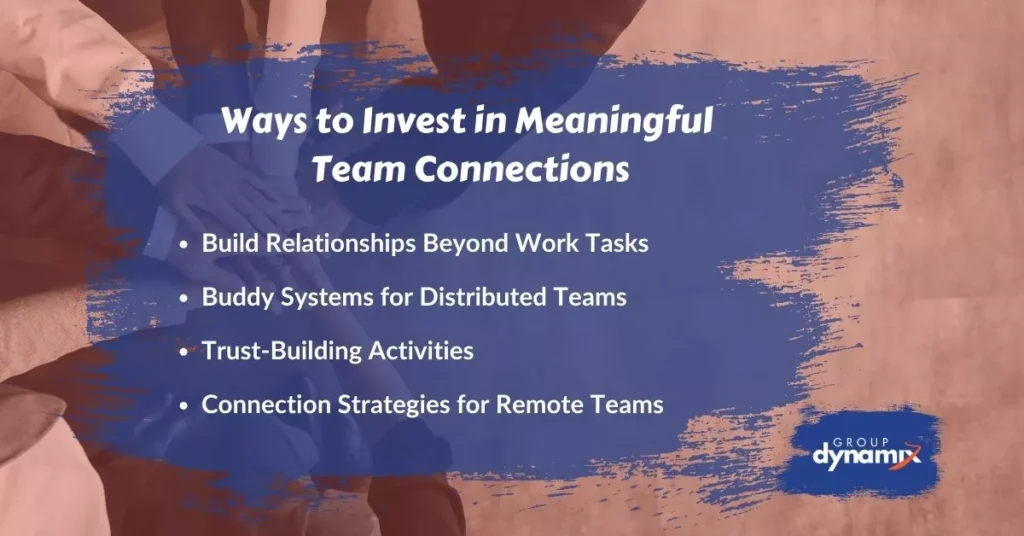
Strategy 7: Invest in Meaningful Team Connections
Trust grows through repeated positive interactions where people experience each other as reliable, competent, and genuinely caring. Relationships built only around task coordination remain transactional. Deeper connections that include some personal familiarity, shared experiences, and emotional understanding create resilient trust that weathers challenges.
This doesn’t require forced fun or invasive personal questions. It means creating space for people to connect authentically as whole humans rather than just role-holders.
Build Relationships Beyond Work Tasks
Informal connections that happen naturally in offices require deliberate design in remote and hybrid teams. Schedule virtual coffee chats, create space at meeting starts for brief personal check-ins, or use pairing systems that introduce team members who don’t normally collaborate.
Share appropriate personal context like hobbies, family situations, or interests outside work so people understand each other’s lives and constraints. This context builds empathy and helps teammates support each other more effectively.
Many teams build strong connection through simple practices: monthly random coffee pairings with optional prompts, team channels for non-work chat that aren’t mandatory, quarterly in-person moments for key milestones, or “working together” blocks where people work synchronously with optional support. When connection strategies fit your team’s culture and constraints, they work. When they feel like mandatory fun or one-size-fits-all corporate programs, they fail.
Buddy Systems and Peer Connection for Distributed Teams
Because chance encounters are reduced in hybrid work, explicit peer-connection structures reduce isolation and provide low-stakes relationships where questions can surface early.
Implementation approach:
Pair new or remote-heavy employees with an established “buddy” for their first months, with weekly 30-minute check-ins and a short guide of suggested topics. Create lightweight rotating pairings or small groups (monthly random coffee chats) that mix remote and in-office members. Encourage peer recognition in shared digital channels where teammates publicly thank each other for help, risk-taking, or candor.
Peer ties across locations mitigate “out of sight, out of mind” dynamics and help remote members access informal knowledge. Having at least one trusted peer increases the likelihood that people will raise concerns or admit mistakes because they don’t feel alone or exposed.
Trust-Building Activities That Actually Work
Effective trust-building activities require psychological stretch in supported environments. Activities like Group Dynamix’s Trust Circle, where team members take turns falling backward into the group, create physical and emotional trust by demonstrating mutual reliance in tangible ways.
Problem-solving challenges that require communication, delegation in the workplace, and visible trial and error help teams practice trust actions in low-stakes settings. Blindfolded communication challenges where some members rely on teammates’ verbal guidance build patience, empathy, and clarity.
The key is pairing experiential activities with professional facilitation and structured debriefs that explicitly connect what happened in the activity to trust behaviors needed back at work. Without this translation, fun activities remain just fun without changing team dynamics.
When to consider professional facilitation vs. self-implementation:
Many teams successfully build connection through simple practices like coffee pairings, team lunches, or shared hobbies. Consider professional facilitation when trust has been severely damaged and teams need neutral third-party support, when your team spans multiple locations and you need intensive connection quickly, or when you want to accelerate development of specific trust skills (vulnerability, psychological safety, delegation) through structured experiential learning.
Adapt Connection Strategies for Remote and Hybrid Teams
Remote teams need more structured connection than co-located ones. Implement recurring “collaboration blocks” where people work synchronously with optional support, create shared digital workspaces that make work visible, and schedule quarterly in-person moments for key milestones like launches or retrospectives.
Use video intentionally rather than defaulting to audio-only calls for important conversations. Seeing faces and body language builds richer connection even through screens. Create informal channels for non-work chat and encourage their use without mandating participation.
Job Demands-Resources framework for hybrid teams:
Many remote-work stressors are structural rather than interpersonal. Map key “demands” on the team (meeting load, time-zone spread, notification volume) and “resources” (autonomy, clarity, tools, support) in a workshop. Ask: “Which demands can we reduce, and which resources can we strengthen?”
Agree on explicit norms: core collaboration hours, response-time expectations, camera use guidelines, escalation process. Document in a shared place and revisit quarterly, asking anonymously how safe people feel to speak up about overload. When teams co-create norms, members feel more control and fairness, which supports trust and increases willingness to flag issues before they become crises.
Balance synchronous and asynchronous communication by codifying which channels serve which purposes, setting clear response expectations, and protecting focus time from constant interruptions. When communication norms reduce friction and uncertainty, trust strengthens because people feel the system is reliable.
How Group Dynamix Can Help: We specialize in tailored, facilitated team-building experiences that create genuine connections through shared challenges, cooperative activities, and guided reflection. Unlike generic events, these customized programs target specific team needs and use skilled facilitators to help groups process experiences and translate them into workplace behaviors. Explore our programs.
Engaging Company Events
Corporate Events, Group Outings, Private Events, Charities, Meetings, and More...
Conclusion
When you build trust in teams, you unlock the foundation for everything else you’re trying to achieve: better collaboration, faster innovation, higher engagement, and stronger results. Trust isn’t built through a single conversation or team-building event, though those moments matter. It’s built through consistent patterns of transparency, vulnerability, clear expectations, psychological safety, reliability, recognition, and genuine connection.
The seven strategies outlined here give you a practical roadmap for strengthening trust systematically. Start with the area that will create the most immediate impact for your team, involve people in shaping the approach, and commit to showing up consistently with actions that match your words.
Group Dynamix has spent years helping organizations build stronger, more trusting teams through customized, facilitated experiences that go beyond typical team-building. Our programs create shared challenges where people practice trust behaviors together in supportive environments, then translate those experiences back to workplace contexts through skilled facilitation. Whether your team needs to improve communication, strengthen psychological safety, or simply connect more authentically, we design programs that meet you where you are.
Ready to take action? Contact Group Dynamix today to explore how our tailored team-building programs can help you build trust in teams, strengthen collaboration, and create the high-performing culture your organization needs to thrive.