
Remote work continues reshaping how teams connect, collaborate, and thrive. When implemented thoughtfully, engagement activities for remote teams don’t just combat isolation—they actively build stronger, more productive working relationships across distances. Remote work, when paired with intentional connection strategies, can outperform traditional models.
Ready to strengthen your remote team’s connections? Discover how Group Dynamix can design customized virtual team building experiences that bring your distributed workforce together.
Benefits of Corporate Team Building?
Benefits of Corporate Team Building?
TL;DR:
Remote team engagement isn’t optional—it’s essential for retention, productivity, and organizational success. This guide presents 25 practical engagement activities designed for distributed teams in 2025, ranging from quick five-minute connection moments to structured professional development programs. The strategies address real challenges remote teams face: isolation, communication gaps, burnout, and disconnection from company culture. When implemented consistently, these activities reduce turnover risk, increase productivity, and create the psychological safety that high-performing teams need. Organizations investing in remote engagement see measurable returns, with 76% of companies experiencing greater employee retention when remote work is allowed.
Key Points:
- Remote workers show higher engagement (31%) than on-site employees when proper engagement strategies are implemented
- Overall global engagement fell to 21% in 2024, costing an estimated $438 billion in lost productivity
- Quick connection activities (5-15 minutes) deliver outsized impact on team cohesion
- Professional development opportunities keep remote employees motivated and growing
- Wellness initiatives address the reality that 86% of full-time remote workers report experiencing burnout
- Facilitated approaches can outperform generic virtual activities, though many organizations successfully run activities internally
Why Remote Team Engagement Activities Are Critical for 2025 Success
The Current State of Remote Work Engagement
Remote work has reached a critical inflection point. While flexibility offers undeniable benefits, overall global engagement dropped from 23% to 21% in 2024—only the second decline in over a decade. This downturn signals that organizations can’t simply replicate pre-pandemic engagement strategies in virtual environments and expect success.
The challenges run deeper than video call fatigue. Manager engagement dropped from 30% to 27% in 2024, with younger managers and female managers experiencing the steepest declines. These leaders find themselves caught between executive demands and employee expectations for flexibility, struggling to foster connection without the natural touchpoints of physical offices.
Yet the data also reveals opportunity. Remote workers, when properly supported, report advantages their office-bound counterparts don’t experience. The key lies in implementing intentional engagement strategies rather than hoping connection happens organically.
Real-World Results: What Actually Works
The difference between theoretical engagement activities and effective ones shows up in measurable outcomes. Really Great Teachers, a global education organization with 100+ distributed staff, implemented quarterly social initiatives they called “Ubuntu”—themed virtual meetups, peer recognition programs, and collaborative challenges alongside wellness check-ins and professional development workshops. Their engagement score increased from 34% (July 2023) to 73% (2025), a 114% improvement demonstrating how consistent, diverse engagement activities compound over time.
Technology firms adopting structured virtual engagement saw similar patterns. Companies implementing weekly informal all-hands meetings, real-time messaging tools for work and social interaction, and asynchronous meeting recordings for time zone inclusion reported up to 30% decrease in voluntary turnover with engagement scores rising 8-15 percentage points post-implementation. Organizations combining wellness challenges, social competitions, and professional growth workshops tracked 15-22% productivity improvement alongside 20-30% drops in turnover.
The common thread? Diverse activity types addressing social connection, wellness, and professional development simultaneously, implemented consistently rather than sporadically.
Impact on Productivity and Employee Retention
The business case for remote employee engagement goes beyond sentiment. 77% of remote workers report higher productivity compared to office-based counterparts, while 78% cite improved work-life balance. These aren’t marginal gains—they represent fundamental improvements in how people work.
Retention follows engagement. In the current job market, 64% of remote-only employees say they are “very likely” to look for another job if denied remote work flexibility in the future. Organizations that dismiss engagement activities as frivolous face tangible costs: losing $1 in every $3 of an employee’s annual salary for each departure, while companies with better retention are 23% more profitable than those with high turnover.
The numbers tell a clear story. Virtual employee engagement activities aren’t expenses—they’re strategic investments that directly impact your bottom line through retained talent, sustained productivity, and reduced recruitment costs.
Key Challenges Remote Teams Face in 2025
Understanding challenges helps organizations choose the right engagement strategies. The most pressing issues distributed teams navigate include:
Isolation and disconnection. 67% of remote workers feel less connected to colleagues, with 25% of fully remote employees experiencing loneliness at work compared to just 16% of fully on-site workers. This isn’t merely about missing lunch conversations—it’s about the absence of informal knowledge sharing, spontaneous collaboration, and the small daily interactions that build trust.
Burnout and boundary struggles. 56% of remote workers report struggling to disconnect after hours, while 81% check work emails outside regular hours and 63% work on weekends. The “always on” mentality creates shadow work that erodes rest time and fuels sustained stress.
Professional development gaps. In 2024, employees received an average of just 13.7 hours of formal learning, representing a dramatic decrease from 17.4 hours in 2023. Remote workers often feel overlooked for growth opportunities, exacerbating feelings of stagnation.
Communication overload without connection. 69% of remote employees report increased burnout specifically from digital communication overload. More meetings don’t equal more engagement—they often achieve the opposite when they lack purpose and genuine interaction.
What Makes Engagement Activities Actually Work
Not all engagement activities deliver equal results. Research on effective virtual team building reveals critical success factors that distinguish genuine impact from performative gestures.
Meaningful interaction matters more than attendance. Activities requiring joint problem-solving, creative collaboration, or strategic teamwork outperform passive gatherings. Companies have seen up to 35% productivity increases in teams where virtual events facilitate focused interaction rather than casual attendance. Measure success by tracking the quality and depth of peer communication, not just participation rates.
Structure drives outcomes. A Harvard Business Review survey found that 72% of employers reported improved collaboration and communication among remote workers post-implementation, especially when activities were structured and goal-oriented rather than purely social. Clear objectives linked to team or organizational goals prevent activities from feeling performative.
Inclusivity and accessibility determine participation. Activities must accommodate different time zones, personal circumstances, and accessibility needs. Virtual offers flexibility, inclusivity, and enhances customer service skills when tools are accessible and activities minimize barriers to entry. Survey team members about preferences and constraints to ensure meaningful participation across demographics.
Technology enables but doesn’t guarantee engagement. Purpose-built tools combining project management features with team-building elements create seamless environments for work and interpersonal connection. However, relying solely on video conferencing limits interaction and creativity. Interactive whiteboards, collaborative apps, and engaging platforms drive higher participation when paired with clear facilitation.
Continuous measurement enables improvement. Track engagement metrics, participation patterns, and qualitative feedback to refine approaches over time. 90% of remote workers reported feeling more connected to colleagues after participating in structured virtual activities, according to a 2022 Owl Labs study, but only when organizations measured and iterated on what worked.
Common Implementation Pitfalls and How to Avoid Them
Even well-intentioned engagement efforts fail when common challenges go unaddressed. Understanding these pitfalls helps organizations design more effective programs.
Communication breakdowns undermine participation. Remote teams often misinterpret tone in messages, miss context due to absent nonverbal cues, or suffer delays from asynchronous communication. A company implementing weekly brainstorming sessions found teams hesitant to participate due to fear of misunderstandings. They resolved this by establishing communication protocols: using video where possible, creating “communication hours” for real-time responses, and leveraging reaction features to clarify tone. Clear norms for response times and message clarity improved both understanding and participation.
Lack of personalization kills engagement. An international tech company noticed declining participation in monthly team-building games, with feedback revealing activities felt impersonal and disconnected from daily work. They shifted to more frequent, smaller-group activities like virtual coffee breaks and shared interest clubs, incorporated personal check-ins before tasks, and encouraged sharing non-work stories. This personalization and regularity fostered belonging and increased active participation.
Technological barriers exclude team members. During a global hackathon, participants from rural areas encountered frequent disconnections and lag, leading to missed deadlines and feelings of exclusion. The company provided equipment stipends, scheduled backup activities not reliant on video, and set up asynchronous participation options like message boards and recorded videos. An IT help desk tailored for remote locations ensured swifter resolutions.
Time zone challenges limit global participation. A distributed sales team scheduled all-hands trivia at times convenient for headquarters, resulting in poor overseas participation. Activities were staggered to occur in local clusters, with winners announced company-wide, and “asynchronous challenges” like week-long photo contests introduced so all could participate on their own schedule. This inclusivity boosted global involvement.
Virtual meeting fatigue breeds resentment. An e-commerce firm insisted on daily virtual standups and weekly game sessions, causing growing resentment as teams found the volume unmanageable. The schedule was revised to bi-weekly themed sessions rotating fun and work-related topics, with some meetings replaced by asynchronous check-ins. This balance reduced fatigue and made remaining activities more valued.
Quick Connection Activities (5-15 minutes)
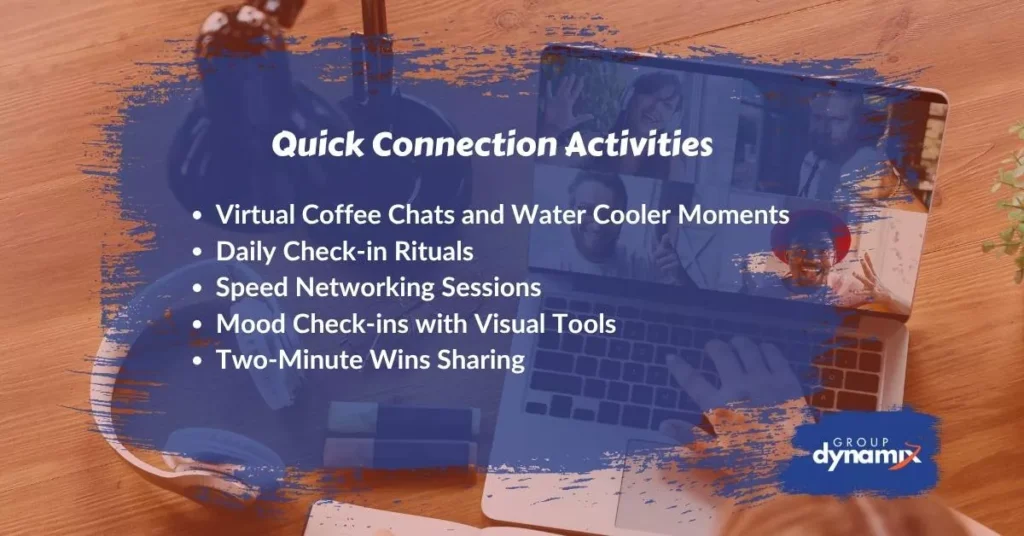
Virtual Coffee Chats and Water Cooler Moments
The spontaneous hallway conversations that naturally occur in offices don’t translate to remote work without intentional design. Virtual coffee chats recreate these moments by pairing team members randomly for brief, informal video calls. A 2024 LinkedIn survey found that 62% of remote employees miss casual interactions, and organizations leveraging tools for random virtual meetups saw team connection scores improve by 20%.
Implement these effectively by scheduling them during natural work breaks, keeping them optional to avoid adding to meeting fatigue, and providing conversation prompts to ease any initial awkwardness. Tools like Donut integrate with Slack to automate pairings, making administration effortless. These micro-interactions compound over time, transforming coworkers into colleagues who know each other beyond project updates.
Daily Check-in Rituals
Brief daily huddles serve as anchors in the sometimes-chaotic world of remote work. Remote teams with regular check-ins report 25% higher engagement scores compared to those without structured interactions. These aren’t status meetings—they’re moments to connect as humans before diving into work.
Effective check-in rituals happen consistently at the same time, last no more than 15 minutes, and include both work-related updates and personal sharing. Try opening each session with a quick question: “What’s one thing you’re looking forward to today?” or “What’s energizing you right now?” Knowing you’ll see your teammates faces daily creates continuity and presence that asynchronous work alone can’t replicate.
Speed Networking Sessions
Speed networking applies the concept of speed dating to professional relationship building. Team members rotate through brief one-on-one video conversations with colleagues they don’t regularly interact with, answering structured questions designed to build connection and understanding.
Structure sessions by creating breakout rooms that rotate every five minutes, providing question prompts for each round, and hosting these quarterly to introduce new relationships without overwhelming schedules. Questions might include: “What’s a project you’re proud of from the past quarter?” or “What’s something most people at work don’t know about you?” These sessions work particularly well for larger organizations where people genuinely don’t know who their colleagues are beyond names in email threads.
Mood Check-ins with Visual Tools
Emotional awareness matters for team health, but not everyone feels comfortable verbalizing their mental state. Visual mood check-ins use simple tools like emoji reactions, color coding, or weather metaphors to let team members signal how they’re feeling without detailed explanation.
Start meetings by asking everyone to drop an emoji in chat representing their current mood, use polling tools that let people select from predefined mood descriptors, or implement daily asynchronous check-ins through team channels. The value isn’t in forcing discussion about every difficult mood—it’s in building awareness so team members can support each other appropriately. Leaders who notice patterns can follow up privately to offer support, addressing issues before they escalate.
Two-Minute Wins Sharing
Recognition doesn’t require formal programs to be effective. Two-minute wins sharing creates space at the start or end of team meetings for members to highlight recent accomplishments—their own or a colleague’s. These moments build a culture of appreciation while keeping everyone informed about team progress.
Make sharing easy and stigma-free: normalize celebrating small wins, encourage peer recognition, and rotate who speaks first to prevent the same voices dominating. Over time, this practice shifts team culture toward noticing and valuing contributions rather than taking good work for granted.
Team Building and Social Activities (30-60 minutes)
Virtual Escape Rooms and Puzzle Challenges
Virtual escape rooms translate the popular in-person experience into collaborative digital problem-solving. Teams work together to solve interconnected puzzles, requiring communication, creative thinking, and coordinated effort—exactly the skills remote teams need to strengthen.
Professional platforms provide themed scenarios ranging from mystery solving to space missions. Choose escape rooms with appropriate difficulty levels for your team’s size and experience, debrief afterwards to connect the activity to real work collaboration, and consider making these quarterly events that teams anticipate. Expert facilitation helps teams extract meaningful learning from the experience rather than treating it as mere entertainment.
Online Game Tournaments and Trivia Nights
Friendly competition energizes teams and creates memorable shared experiences. Online game tournaments and trivia nights offer accessible engagement that requires minimal technical setup while delivering maximum participation.
Popular options include trivia competitions covering company history, pop culture, or industry knowledge, digital versions of classic games like Pictionary or Charades, and multiplayer gaming sessions for teams that enjoy video games. Keep scores lighthearted and consider small prizes that add excitement without creating unhealthy competition. Digital gift cards, extra PTO hours, or bragging rights trophy emojis work well.
Show and Tell Sessions
Show and tell taps into our natural desire to share what matters to us. Team members take turns presenting something significant to them—a hobby, a collection, a skill they’re developing, or even a virtual tour of their workspace or hometown.
These sessions humanize colleagues beyond their work roles. Learning that your project manager restores vintage motorcycles or that your developer volunteers at an animal shelter creates connection points that strengthen working relationships. Schedule these monthly, keep presentations to five to ten minutes, and make participation entirely voluntary.
Virtual Cooking or Mixology Classes
Shared learning experiences create bonds through common struggle and achievement. Virtual cooking or mixology classes give teams something tangible to create together, even while apart.
Send ingredient lists ahead of time, hire an instructor to lead the session via video, and build in time for participants to show off their creations and share tasting notes. These classes work well as celebration events marking project completions or team milestones. The informal atmosphere, combined with the slight chaos of everyone cooking simultaneously, generates authentic laughter and connection.
Digital Scavenger Hunts
Digital scavenger hunts combine creativity, competition, and collaboration. Teams race to find or create items based on prompts, submitting photos or videos as proof.
Effective hunts include a mix of challenges: find something in your home office that represents your work values, create a team logo using only household items, take a photo with a pet or neighbor (with permission), or find the most unusual object within arm’s reach and explain its story. Time-box the activity (30-45 minutes works well), use breakout rooms for team strategizing, and create a shared space where all teams can view each other’s submissions.
Professional Development and Growth Activities
Skill-Sharing Sessions and Internal TED Talks
Your team possesses collective expertise that often remains siloed. Skill-sharing sessions create forums for team members to teach each other, building professional development opportunities while strengthening relationships.
Invite team members to present 15-20 minute talks on their areas of expertise, whether directly work-related or adjacent skills. A marketing team member might share content creation strategies, while someone from finance explains budgeting basics. Non-work skills like productivity techniques or photography tips add variety. These sessions address the concerning reality that 90% of organizations are experiencing a major or minor leadership skills gap. Internal knowledge sharing helps fill gaps while costing nothing beyond time investment.
Virtual Mentoring Programs
Formal mentoring relationships support career development and combat the isolation that can stunt professional growth in remote settings. Virtual mentoring programs pair less experienced team members with seasoned colleagues for regular guidance conversations.
Structure programs with clear timeframes (six to twelve months works well), defined goals that mentees set with their mentors, and monthly virtual meetings supplemented by asynchronous communication. Successful programs also include group sessions where multiple mentor-mentee pairs meet together, creating community and enabling peer learning. The benefits flow both directions: mentees gain guidance and advocacy, while mentors develop leadership skills.
Cross-Department Shadow Sessions
Remote work can create information silos where team members understand their immediate responsibilities but lack broader organizational context. Cross-department shadow sessions let employees virtually “shadow” colleagues in different departments, learning how their work connects to the bigger picture.
Schedule two-hour sessions where an employee joins another department’s meetings and workflows, explains their own role to their shadow and answers questions, and connects the dots between how different departments collaborate. Follow up with brief written reflections on what participants learned. These sessions build empathy across departments and reveal collaboration opportunities that might otherwise remain hidden.
Industry Trend Discussion Groups
Keeping skills current matters for employee engagement and organizational competitiveness. Given that 83% of companies use e-learning for employee training and 68% of professionals prefer online courses over in-person workshops, creating virtual spaces for industry trend discussions meets employees where they already prefer to learn.
Establish monthly discussion groups focused on industry trends, new technologies, or methodological approaches. Rotate facilitation responsibilities so different team members lead discussions, assign relevant articles or videos as pre-reading, and encourage application discussions connecting trends to your team’s work. These conversations position your organization as invested in staying current while giving employees voice in shaping how the team evolves.
Lunch and Learn Workshops
Lunch and learn sessions combine professional development with the natural mid-day break, making learning feel less like added work burden. These 45-60 minute virtual sessions cover topics relevant to team members’ professional growth.
Content sources include internal experts sharing specialized knowledge, external speakers presenting on industry topics, recorded course content watched together with live discussion, or skill-building workshops on tools and techniques. Encourage participation by keeping attendance optional, providing lunch stipends or delivery gift cards, and recording sessions for those who can’t attend live. The informal format removes barriers that more formal training might create.

Wellness and Mental Health Initiatives
Guided Meditation and Mindfulness Sessions
Mental health support can’t remain optional given that only 34% of employees report having meaningful mental health support from their employer, despite 43% reporting increased stress levels in 2024. Guided meditation and mindfulness sessions provide practical stress management tools.
Partner with platforms like Meditopia, which specializes in scalable solutions for remote teams with guided meditation, mindfulness resources, and mental health support. Alternatively, bring in certified instructors for live sessions that teams attend together. Offer sessions at various times to accommodate different schedules, keep them optional to avoid adding stress, and create quiet channels where team members can share mindfulness resources and support each other’s practices.
Virtual Fitness Challenges
Physical wellness directly impacts mental health and work performance. Virtual fitness challenges gamify movement and health goals, creating accountability and camaraderie around wellness.
Effective challenges include step competitions tracked through integrated apps, group classes (yoga, HIIT, stretching) led by instructors via video, hydration or sleep tracking challenges, or team-based goals where collective efforts count toward shared milestones. Platforms like Vantage Fit excel in activity and fitness challenge tracking, including steps, calories, and sleep, with integration to trackers like Fitbit and Apple Health. Make participation inclusive by offering multiple challenge types that accommodate different fitness levels.
Mental Health Check-ins
Regular mental health check-ins normalize conversations about wellbeing and help leaders spot team members who need additional support. These differ from mood check-ins by going deeper and offering resources.
Implement through quarterly anonymous pulse surveys asking about stress levels, workload manageability, and support needs, optional one-on-one check-ins between managers and team members focused on wellbeing, and shared resources (articles, hotlines, EAP information) through regular team communications. Platforms like Unmind provide evidence-based mental health tools specialized for organizations, offering self-guided courses, mood tracking, and personalized assessments. The goal isn’t solving every problem but creating an environment where seeking help feels safe and supported.
Work-Life Balance Workshops
Boundaries blur dangerously in remote work. Work-life balance workshops give teams concrete strategies for managing the unique challenges of working from home.
Workshop topics might include time management techniques specific to remote work, communication boundaries (when to respond to messages, when to disconnect), workspace optimization for mental separation between work and home, and energy management strategies for sustainable performance. Bring in experts who specialize in remote work wellness or tap internal team members who’ve developed effective practices. Follow workshops with implementation support: check-ins on how new strategies are working and leadership modeling of healthy boundaries.
Digital Detox Challenges
Digital detox challenges help teams step back from screens intentionally. Structure challenges by encouraging no-screen lunch breaks where cameras stay off, email-free evenings or weekends (except genuine emergencies), phone-free morning or evening hours, or complete unplugging during vacation time.
Make these challenges about addition rather than deprivation. What activities replace screen time? What do team members rediscover when not constantly connected? Frame it as gaining presence rather than losing connectivity. Track participation through honor system plus optional sharing of how time away from screens was spent.
Recognition and Celebration Activities
Peer Recognition Programs
Traditional top-down recognition matters, but peer recognition often carries greater emotional weight. Virtual recognition programs increase employee engagement by 30% while addressing the stark reality that 82% of remote workers feel unrecognized—representing a major risk for retention and morale.
Implement peer recognition through platforms like Bonusly, which offers real-time peer recognition, points-based rewards, robust integrations with Slack and Microsoft Teams, and social recognition walls for transparent team appreciation. These tools make recognition visible and frequent rather than rare formal events. Effective programs encourage recognition for both major achievements and everyday helpfulness and make giving recognition as easy as sending a message.
Virtual Achievement Ceremonies
Milestones deserve celebration, and virtual ceremonies can feel surprisingly meaningful when designed thoughtfully. Recognition lowers voluntary turnover by 45% and regular recognition lowers burnout by 73%, making these events strategic investments.
Host quarterly virtual ceremonies celebrating project completions, work anniversaries, performance achievements, or team milestones. Make them memorable by sending participants celebration kits (small gifts, treats, or company swag) ahead of time, including video messages from leadership congratulating specific individuals, creating visual awards or certificates shared on screen, and building in time for honorees to share brief remarks. Platforms like Workhuman specialize in virtual achievement ceremonies with social recognition walls, milestone celebration tools, and deep HR integration.
Milestone Celebration Events
Beyond formal achievements, personal milestones create opportunities for team connection. Celebrating birthdays, work anniversaries, major life events, or personal accomplishments shows team members they matter as complete humans.
Create systems to track and acknowledge these moments: shared calendars of upcoming celebrations, designated “celebration channels” in team communication platforms, monthly events recognizing everyone with milestones that month, or peer-nominated celebrations where team members nominate colleagues whose achievements deserve recognition. Keep celebrations optional and culturally sensitive, recognizing that not everyone wants attention for personal events.
Team Appreciation Walls
Visual spaces dedicated to appreciation create ongoing recognition rather than one-time moments. Digital team appreciation walls serve as living records of gratitude and acknowledgment.
Tools like GoProfiles or Kudos provide customizable recognition badges, searchable social walls showing all recognition given, integration with tools like Slack for seamless workflow, and analytics showing recognition patterns. These walls become places team members visit regularly to give and receive appreciation. Seed the wall with leadership recognition to model the behavior and encourage specificity in appreciation (what exactly someone did and why it mattered).
Success Story Sharing Sessions
Success story sharing sessions invite team members to present project wins, lessons learned from challenges, innovative solutions they developed, or client feedback they received. These sessions serve dual purposes: recognition for the presenters and learning opportunities for everyone else.
Structure sessions casually, with 10-15 minute presentations followed by questions and discussion. Focus on storytelling rather than formal reporting—what made the success possible, what obstacles were overcome, who contributed along the way. These sessions build organizational knowledge while ensuring good work receives visibility and celebration across the team.
Group Dynamix: Professional Facilitation for Remote Teams
For organizations choosing facilitated approaches, Group Dynamix brings expertise in creating meaningful virtual engagement experiences. Their facilitator-led, customized methodology differs from generic virtual activities by designing fully live-streamed team building experiences with multi-camera events specifically created for virtual participation.
Their approach incorporates digital cooperative challenges—interactive team activities like problem-solving games and virtual icebreakers—that promote teamwork, trust, and communication among remote employees. These aren’t off-the-shelf solutions but experiences crafted to meet specific team objectives, whether building unity, fostering resilience across digital boundaries, or creating moments of connection and fun.
Group Dynamix also integrates wellness into engagement through mindfulness and wellness-themed sessions. These events can weave mindfulness practices, stress-reduction exercises like guided breathing or creative reflection, and wellness-focused group discussions into team building formats that promote self-care and mutual support. The company works closely with organizations to customize programs according to wellness, mindfulness, or resilience objectives relevant to remote teams.
Professional facilitators lead sessions specifically designed to boost morale, create fun shared memories, and re-energize staff—even when delivered remotely. Rather than leaving teams to navigate activities alone, expert facilitation ensures experiences drive the intended outcomes while remaining enjoyable and
Engaging Company Events
Corporate Events, Group Outings, Private Events, Charities, Meetings, and More...
Engaging Company Events
Corporate Events, Group Outings, Private Events, Charities, Meetings, and More...
Conclusion
Engagement activities for remote teams represent essential infrastructure for organizational success, not optional perks. The 25 ideas presented here address real challenges distributed teams face: isolation, burnout, disconnection, and the erosion of culture that distance can cause. From five-minute mood check-ins to comprehensive virtual mentoring programs, each activity type serves specific purposes in building cohesive, motivated remote teams.
The data conclusively shows that 31% of fully remote workers are engaged when proper strategies are implemented—outperforming traditional work models. Organizations that invest in remote work engagement see returns through higher retention, sustained productivity, and workplace cultures where people choose to stay and contribute their best work. With 64% of remote workers ready to leave if forced back to offices, maintaining flexibility while strengthening connection becomes strategic imperative.
Success requires consistency over intensity. Regular quick connection activities often deliver greater impact than occasional elaborate events. It demands customization—understanding your specific team’s needs, challenges, and preferences rather than implementing generic programs. Most importantly, it requires commitment from leadership to model engagement, participate authentically, and resource these initiatives appropriately.
Whether you choose DIY approaches, professional facilitation, or hybrid models, the critical factor is intentionality. Remote engagement doesn’t happen accidentally—it requires deliberate design, consistent execution, and willingness to measure and adapt based on what your team actually needs.
Ready to transform how your remote team connects and collaborates? Contact Group Dynamix to explore customized virtual team building solutions designed specifically for your distributed workforce’s needs and goals.